
World Cup: Bread, Circuses and the Fruit of Migration

The hard and fast rule of major global sporting events — Olympics or World Cup — is that in the months leading up to them there will be constant reports of impending disaster. Stadia unfinished, ticket prices sky high, general infrastructure collapse.
Then, once the event starts, all is forgotten. People around the world watch in their billions. Because, as Juvenal pointed out, almost 2000 years ago, “bread and circuses” are what we want.
Or, as a friend who is militantly disinterested in the football but charmed by the scenes of fans coming from the US pointed out,
“People crave a little levity, a little joy.”
Especially now, especially in America.
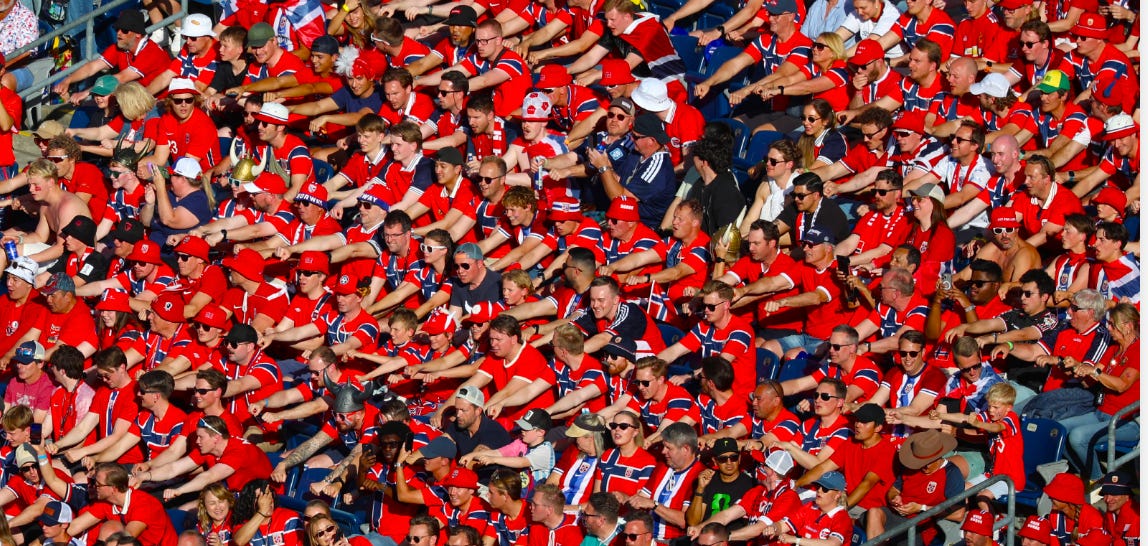
I have been through many cycles of pre-World Cup “this will be a disaster” and forgetting about it once the first ball is kicked but even I have been surprised by how joyous this opening round of the tournament has been.
Here is a two-part theory about why this should be: it has a lot to do with how much the nature of football fandom has changed over several decades.
First, and in the case of the World Cup most important, the genesis of fandom is completely different. It used to be simple: you were born in England, you supported England, in France, France, in Germany die Mannschaft etc.
But as you may have noticed, the world has been on the move the last four decades, from South to North, mostly. This has created social tensions playing out in politics but for this World Cup, being held in the country most in political distress dealing with the effect of immigration, this movement of people has built a cosmopolitan fan base.
How many of the fans in Boston the other night cheering on Ghana as they stymied and stifled England’s attack had flown in from Accra and how many were among the estimated quarter of a million Ghanaian immigrants now living in America, a fair number of whom live in Worcester, MA?
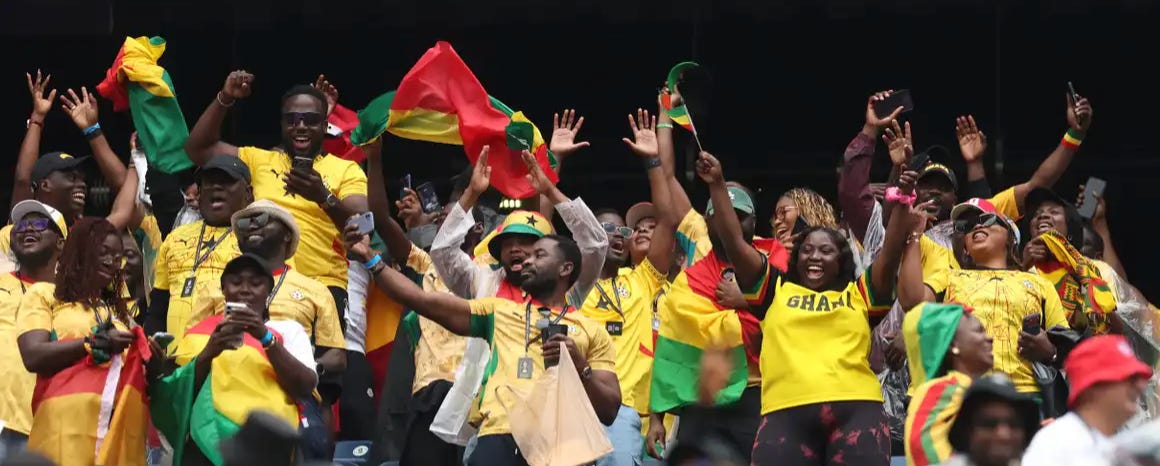
But it’s not just Ghanaians. Virtually, every country competing in this World Cup, has a substantial immigrant community in America to turn out and support it. According to the most recent US census data 14.3% of the American population was born overseas. That’s nearly 48 Million foreign born citizens/residents in the country.
Who do they cheer for? 35 years ago Norman Tebbit, anti-immigration English nativist and close adviser to Margaret Thatcher, said in an interview with the LA Times:
"A large proportion of Britain's Asian population fail to pass the cricket test. Which side do they cheer for? It's an interesting test. Are you still harking back to where you came from or where you are?"
Tebbit died last year. The relevance of his question pre-deceased him by several decades.
Fans don’t really care who plays for their team or where they come from. They can’t if they’re English or French or German or American because so many of the players on those teams are from somewhere else. Almost a quarter of all players in this World Cup are playing for countries other than the one where they were born.
The cosmopolitan make up of teams is greater still if you include players whose parents are recent immigrants.
Multi-culturalism is not some meaningless phrase when it comes to football — fans want their teams to win and they don’t care about Tebbit tests and points of origin any more. The best players need to be on the pitch, don’t care when their families arrived in the country.
There was a moment in that Ghana-England match where three of Arsenal’s British Nigerians were on the pitch at the same time: Bukayo Saka, Eberechi Eze, and Noni Madueke, a fourth, Ethan Nwaneri trained with England during the warm-ups for the tournament (note to Mikel Arteta — find a way to get all four on the pitch at the same time next season if you want to win the Champions’ League).
A fifth British Nigerian with Arsenal connections, Michael Olise, is a crucial player for France. Why France? His mother is Franco-Algerian. A sixth British Nigerian with Arsenal connections, Folarin Balogun, stars for USA in this tournament because of his accidental birth in the US — his mother, heavily pregnant with him was visiting relatives in Brooklyn and not allowed to fly back until she had given birth. In Trump’s America this would normally lead to ICE breaking down the door and deportation proceedings, but since Balogun is a great young player, his birthright citizenship is put to use.
Nigeria did not qualify for this World Cup. Those six would form the nucleus of a team that could probably get to the semi-finals of this tournament. So, who do Nigerian fans cheer for in this tournament?
There is joy to be had in a tournament where the old tribalism no longer works because of the cosmopolitan nature of teams now.
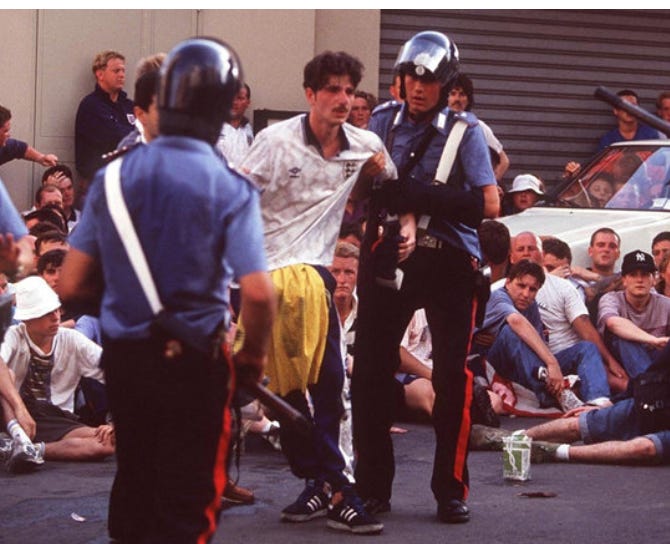
Stephen Yaxley Lennon aka Tommy Robinson, convicted criminal and race-baiter, beloved of white supremacists Steve Bannon and Elon Musk, started out as a football hooligan. The bad old days of English football hooliganism came to an end around the time the Tebbit test became irrelevant 30 years ago.
The second reason for joy in the streets of America (except around the White House and the Reflecting Pool) is the fact that being inside the stadium is no longer necessary for the communal fan experience because most people can’t afford it. Tickets to the games are beyond the reach of ordinary working stiffs and those, like me, who rely on paid subscriptions and donations to survive.
The days when I could look out the window, see that it wasn’t raining, the Arsenal were at home, and wander over to Highbury, slap a few coins down and stand at the Clock End are a half a century past.
Today, going to a match is an event and an expensive one. £100 ($130) for a seat with a decent sightline at mezzanine level — but there are very few such seats available for any given match, You have to go to the secondary market and pay a scalper well over the face value of a ticket to get in.
Most fans put on their colours and go to the pub and watch on TV. We suffer together (and if you’re an Arsenal supporter you know just what suffering is).
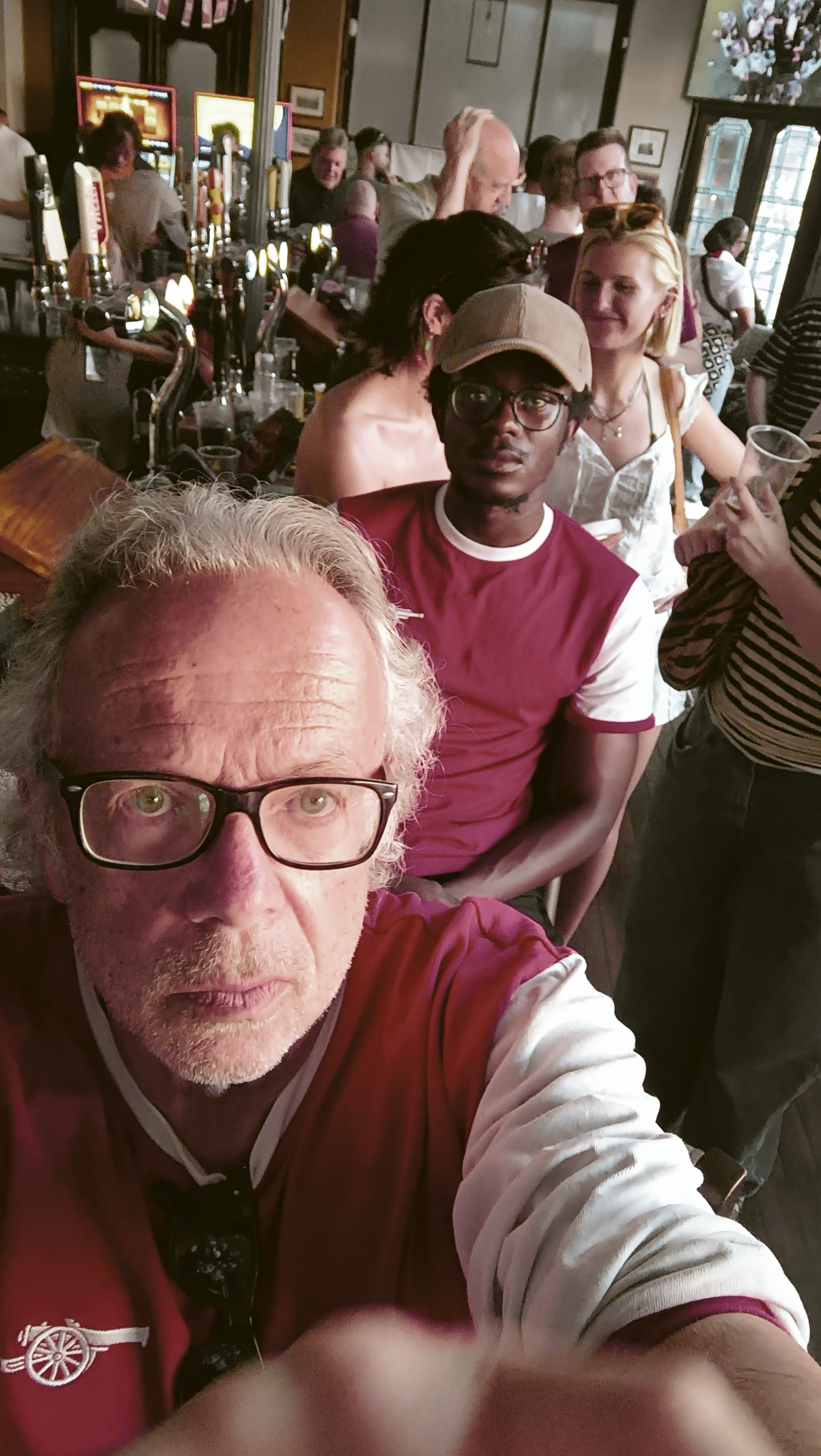
But we have the complete fan experience. We scream at the ref together, shout at the manager to get so and so off the pitch and a replacement on. We have the same communion that we once had on the terraces. There is no shame in not being inside the stadium because we know most people can’t find tickets and and how few can afford them if they do.
So fans have traveled to America without tickets, knowing there would be big outdoor screens and plenty of bars showing matches. Their experience of spectating and community will be what they are used to from regular league matches.
They are joined in the streets by Americans delighted for an opportunity to forget who is running the country into the ground. They join in the Viking row or stand around and cheer for it. The newspapers fill with feel good stories about Scottish supporters drinking dry all the bars in Boston. They nod and high five people in traditional dress everywhere from Japan to Senegal.
I won’t predict who will win the World Cup (don’t bet against France though, God they are great. Led by Cameroonian-Kabylean Kylian Mbappe, Malian-Mauretanian-Senegalese Ousmane Dembélé at the front, and Lebanese-Cameroonian William Saliba at the back — all French born)
But I will predict that when Trump presents the trophy to the winner he will be roundly booed as he represents the antithesis of everything the game has become and the new joy that comes with it.
and one last thing:
Thank you, Michael. You hit the nail on the head for diversion & distraction. Thanks.
Good advice for Arsenal too!