
SEIZING THE MOMENT
A Lesson from Iran 25 Years Ago

Over the past two weeks in the US and Iran security services have been running amok, ICE on the streets of Minneapolis, the IRGC on the street of Iran’s major cities.
Social media is on fire with comparisons.
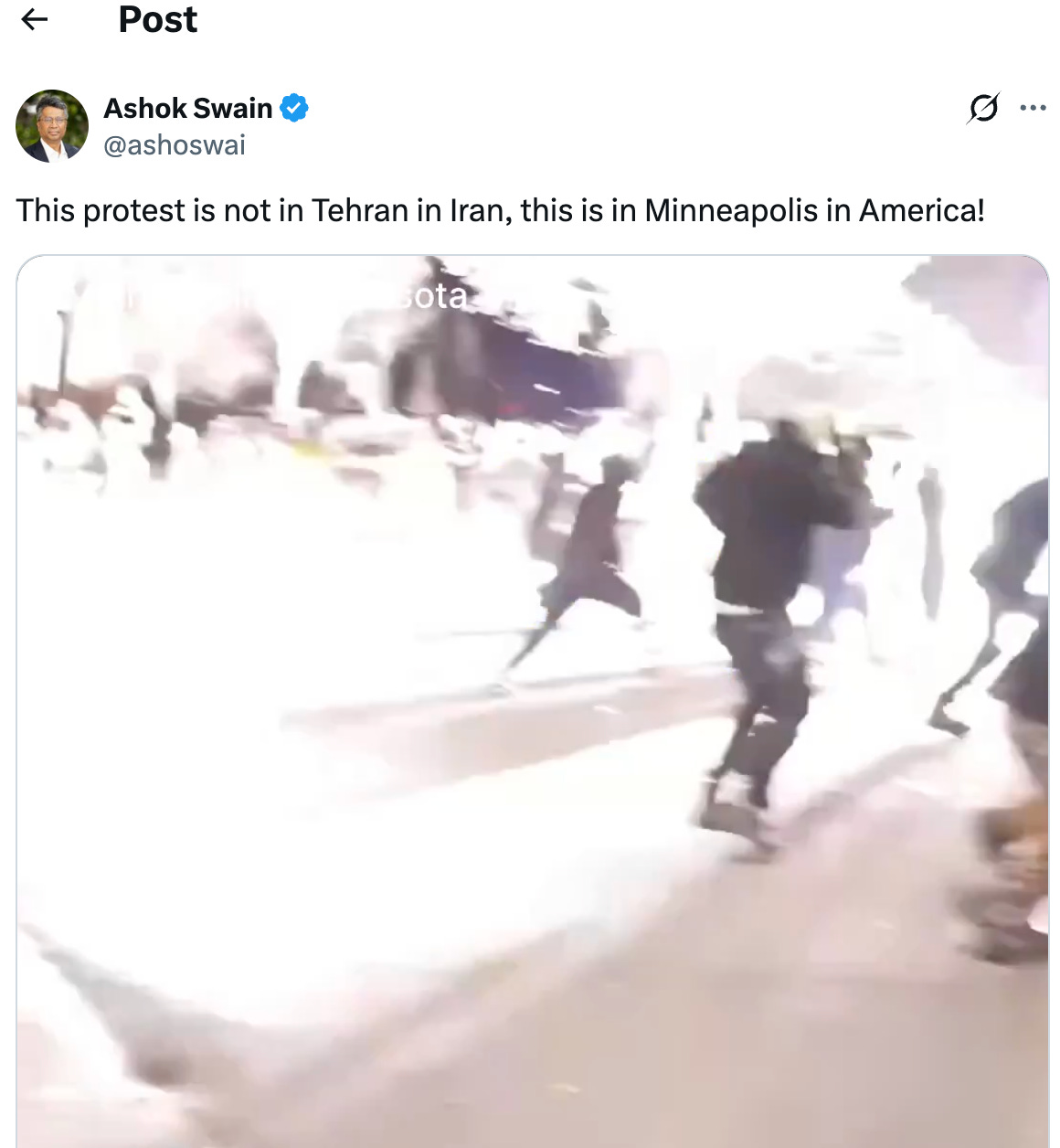
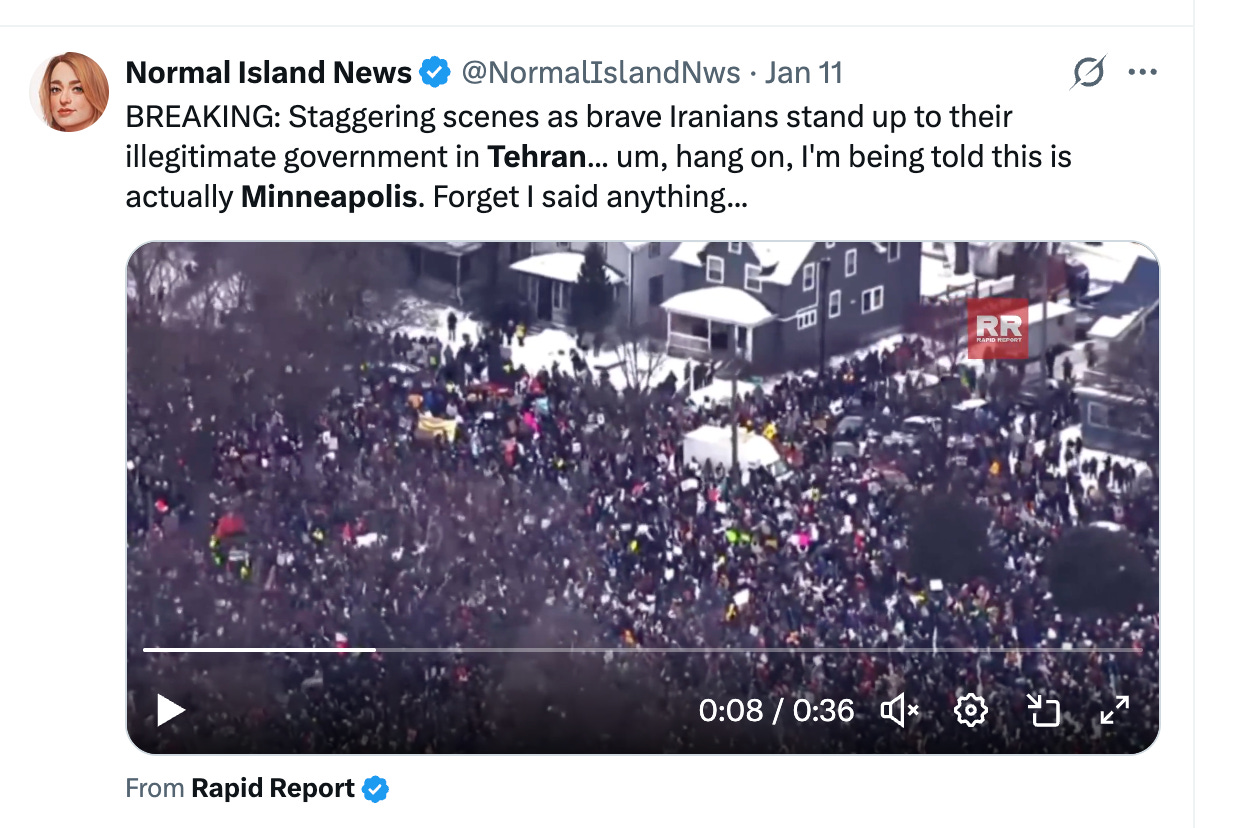
But there really is no comparison between what is happening in the two countries, either in the scale of violence committed by the government against its citizens or in its origins.
The Islamic regime is still a revolutionary phenomenon, probably in its end stage. What is happening in the US is a counter-revolution, ironically/synchronously taking place on the 250th anniversary of the beginning of America’s own revolution, and it is only just beginning.
In Iran, nearly half a century after the Islamic Revolution overthrew the Shah, the theocrats are clinging to power the old-fashioned way — through massive, violent repression. In the US, the MAGA regime is using violence and repression to steer the country away from the constitutional republic envisioned by its founders towards becoming an oligarchy with ethno-religious characteristics.
One of the most crucial differences is in the organizational skill with which repression is being carried out. The various internal secret police forces in Iran are disciplined and they are not constrained from extreme violence including torture by constitutional structures.
The MAGA regime, still operates within a legal framework, albeit frayed. It’s approach is a reflection of the chaotic mind of Donald Trump: racist but also ill-disciplined and hungry to do things that will make good TV. This is a horror but also a saving grace. The chaos and lack of organization means the victim count in the US doesn’t begin to match that of Iran.
Looking at the images in social media from Minneapolis did make me think of Iran, however. The idea behind First Rough Draft of History, was to put current events into historical context drawing on my decades as a journalist, writing history’s first rough draft — and just having lived through “interesting times”.
In 2001, just after 9/11, I made a documentary called Revolutionary Islam for WBUR, the Boston NPR affiliate. In those frantic days after the attacks, the piece sought to explain this seemingly new phenomenon — radical Islam — that had in fact been bubbling along for decades unnoticed by most in the “West”. I reported from Egypt and Iran because despite doctrinal differences between the two, Sunni Islamic radicals in Egypt aspired to the success of the Iranian Revolution.
It was an interesting moment to visit the Islamic Republic of Iran. It was a couple of decades since the Islamic Revolution and a slight loosening of the theocratic laws governing the country was underway. Mohammed Khatami, a cleric, viewed as a reformer was president.
In those first weeks after al-Qaeda’s attacks on the World Trade Center and Pentagon, Iran was cooperating with the US, aka the Great Satan, as it prepared to invade Afghanistan and overthrow the Taliban. It may have been no more than the “enemy of my enemy is my friend” thinking but there was a good strategic reason for aiding the US. In the eastern part of the country, Iran shares a 570 mile long border with Afghanistan. Much of that part of Afghanistan is Shi’a as is Iran. The Talibs, of course, are Sunni.
After a few bureaucratic delays I got a visa and after a pro forma visit to the Ministry of Islamic Guidance and Culture, which had issued my press pass, was pretty much allowed to go wherever I wanted and speak to anyone.
This past week, as the latest uprising against the government became bloodier and Trump bloviated his way towards intervention before backing down at the request of his business partners, the Gulf States and Saudi Arabia’s monarchs plus Israel’s Bibi Netanyahu, I listened back to the Iran section of the documentary. Here it is:
Listening again a few things stood out: the sense of people making accommodation with the regime because “reform” was in the air. That reform had been delivered via the ballot box. Gradually religious restrictions were eroding. Iran is actually very modern, with modern problems that were beyond the scope of theocratic rule based on Sharia law. People didn’t want outside intervention to overthrow the Ayatollah’s, they were certain the regime would erode from within via existing democratic processes.
They were wrong. As it turned out it was just the midpoint in the life of the regime. Despite regular uprisings against their government, starting with the 2009 Green Revolution, Ayatollah Khamenei remains entrenched in power.
A quarter century later listening back to that report, it is hard to think that the young people in it, celebrating the Iranian football team’s victory, are now all approaching 50 and still living in an increasingly harsh theocratic dictatorship. It is painfully easy to imagine their children — now the same age as they were in 2001 — being slaughtered the last two weeks.
In Tehran I was helped out by a young Iranian-American journalist, Azadeh Moaveni. She has gone on to have a major career. This past weekend she had an excellent article in the Financial Times putting the last few weeks’ uprising into an economic context whose origins go back to the first Trump administration.
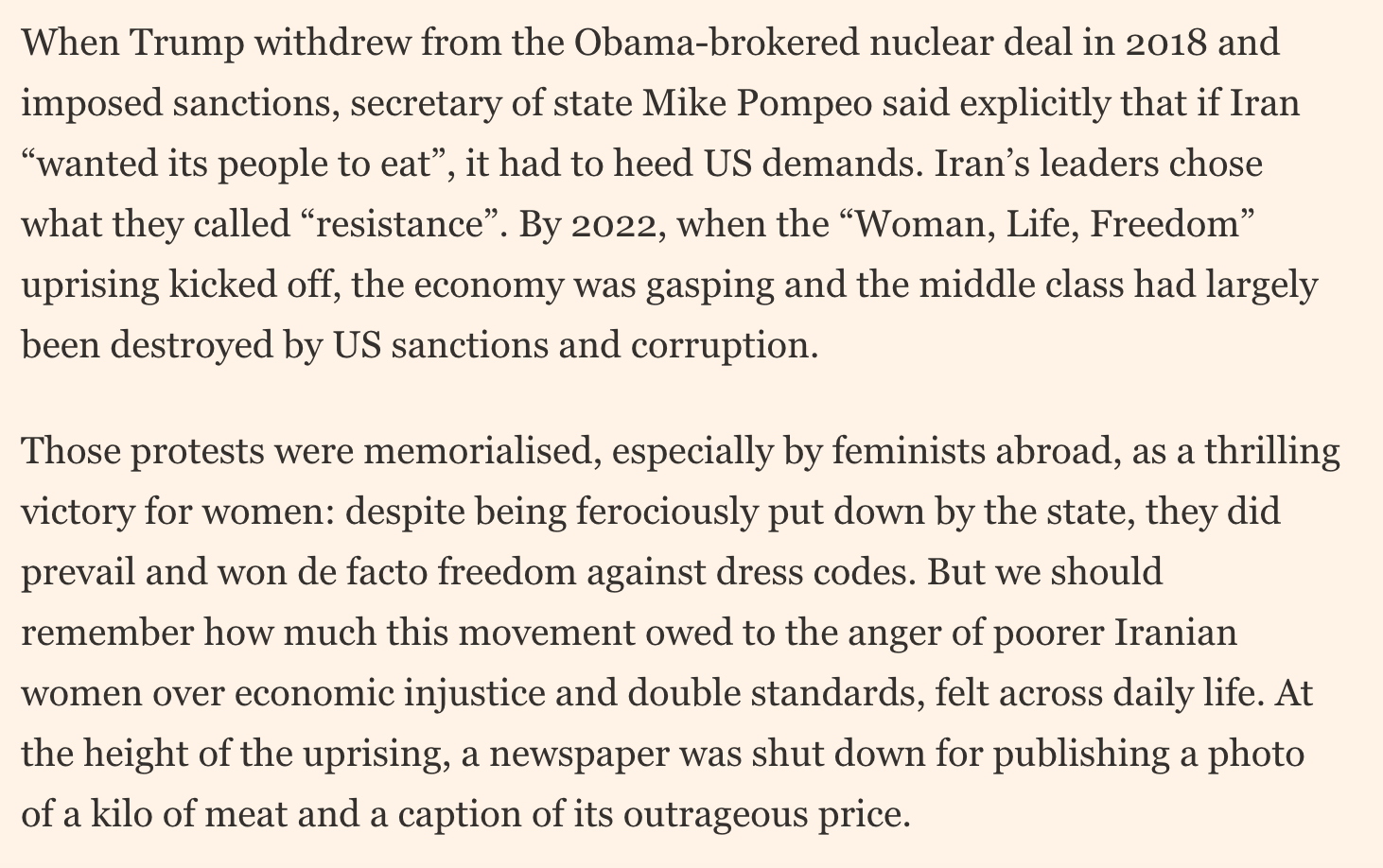
Moaveni goes on to quote the grandson of Ayatollah Khomeini
“Any tree whose fruit is poverty and deprivation is a wicked tree,” he said. Economic fury runs through every recent moment of clamour in Iran like a guiding line.”
This is a critical difference between 2025 and 2001.
The poor who provided so much of the energy and the recruits that sustained the repressive mechanisms of the state are suffering now and perhaps turning against the regime — but not yet in numbers that could lead to its overthrow.
“Freedom and wealth for the elites, fear and penury for everyone else.”
The regime is now passed down through the generations. The senior clerics and leaders of the Islamic Revolutionary Guard Corps have grown wealthy through corruption, many of them raise their children in the kind of affluence associated with Los Angeles (Tehrangeles as it is known in Iran because of the large number of Iranian exiles who live there).
Their networks of patronage are wide and include all those who were out in the streets slaughtering their fellow citizens. Should the regime fall those murderers know they will not be treated kindly.
When you consider this picture there really is not a lot of comparison between MAGA’s first attempt at anti-democratic repression in the US and what is going on in iran. Not just scale of violence but also time-scale: MAGA hasn’t been in power for nearly half a century. But there are historical processes that are analogous.
Corruption in Trump Mk II is off the charts. Authoritarian regimes buy personal loyalty because the bargain is the leader will keep you out of prison for illegal business practices.
The shock troops that enforce with violence the regime’s commands are those who already hate vast numbers of their fellow citizens and once they have started murdering them, as Jonathan Ross murdered Renee Good, these troops know the justice — rough or legal — they will face will be harsh if the regime falls.
And the younger enablers in the upper echelons of the MAGA/Republican Party, the Marco Rubio, Mike Johnson, Josh Hawley types know that their dishonor, as Liz Cheney foretold, will remain and their careers will be ruined when Trump falls.
As for nepotistic passing along of wealth and power: from Trump’s children to Jared Kushner to David Ellison, now the proud owner of pro-MAGA CBS. Their lives and those of their children are guaranteed as long as the regime continues. Do you think they will use whatever means necessary to maintain their position?
Authoritarian regimes copy each other. Trump and co are already imitating how Viktor Orbán has gone about consolidating power. This past week, as it prepared for its fightback, the Iranian regime cut off the internet inside the country. You have to wonder if Trump would attempt to do the same thing around the midterms, when tensions will reach a peak as the polls make it clear that Americans are likely to deliver him a stinging rebuke.
Not that you can cut off access to the web completely. Throughout the week Iranian families were able get some videos out of the country. Take a second to watch, as a tribute to their courage.

But there is one useful comparison to Iran from 25 years ago and a lesson for Americans to take from it: When you are in the grip of revolutionary or counter-revolutionary times, with the old political framework having been thrown out, do not put too much faith in voting for people offering incremental “reform”. As someone who is very much committed to the American ideal of democracy and the ballot box, that is very hard to think much less to write. And so is this:
Be prepared to seize the moment by the throat, as if you were in hand to hand combat, and squeeze the life out of the movement that would squeeze the life out of American democracy. That is MAGA’s stated goal. Take them at their word.
And do it before the regime beds down and its networks of patronage reach critical mass.
This is so superb Michael! Not a surprise! But each time is a revelation! I do worry about your ever getting back into the United States so long as MAGA holds power.
Thanks, as always, Mike. You are right there now. The point of no or little return. Incrementalism will NOT DO IT. The resolve needed is truly immense. Will we find it or not? That is the question.